The most important features to look for in a high-quality electric salt and pepper mill are grinding mechanism material, grind size adjustability, motor strength, battery life, and ease of one-handed operation. These five factors determine whether a mill delivers consistent, fresh seasoning for years — or ends up in a kitchen drawer after six months. Secondary features like lighting, capacity, and material finish matter too, but only once the core mechanics are sound.
This guide breaks down every feature worth evaluating, explains what separates good from great, and gives you specific benchmarks to compare products before buying.
Grinding Mechanism: The Most Critical Component
The grinding mechanism is the heart of any electric salt and pepper mill. No amount of elegant design or smart features compensates for a weak or poorly made grinder. The mechanism determines grind consistency, durability, and which spices the mill can handle.
Ceramic vs. Stainless Steel Burrs
The two dominant burr materials are ceramic and stainless steel, and the right choice depends on what you are grinding:
- Ceramic burrs are non-corrosive, making them the preferred choice for salt. Salt is highly corrosive and will degrade stainless steel burrs over time — even so-called "rust-resistant" grades. Ceramic burrs are also harder than most spices, producing a consistent grind without absorbing odors or flavors. A quality ceramic burr should last 5–10 years under regular daily use.
- Stainless steel burrs are more durable for hard peppercorns and specialty spices like Sichuan pepper or dried chili flakes. They handle tougher loads without chipping. However, they should never be used for salt over extended periods without a protective coating.
- Best configuration: Ceramic burrs for the salt mill, stainless steel for the pepper mill — or a dual-ceramic setup if you grind salt exclusively.
Burr Diameter and Grinding Surface Area
Larger burr diameter means more grinding surface area, which translates to faster output and more consistent particle size. Budget mills often use burrs as small as 18–22mm in diameter. Quality mills use burrs of 28–38mm, producing noticeably smoother, more even grinds at higher output rates. If a manufacturer does not publish burr diameter, that is often a signal that it is undersized.
Grind Size Adjustability
A high-quality electric mill should give you meaningful control over grind coarseness. The difference between a fine grind for finishing a dish at the table and a coarse grind for a crust on steak is significant — and a mill with only one fixed setting forces you to compromise on both.
Number of Settings
Entry-level mills offer 3–5 grind settings. Mid-range and premium mills offer 6–8 or continuously variable adjustment. For most cooking needs, 5 or more distinct settings is adequate. Look for a clearly marked adjustment mechanism — dial, twist-ring, or button — that holds its setting without slipping during operation.
Adjustment Mechanism Location
Grind adjustment is typically located at the top or bottom of the mill. Top-mounted adjusters are more convenient — you can change the setting mid-use without turning the mill upside down and spilling contents. Bottom-mounted adjusters are more common on budget models and are less practical during active cooking.
Particle Size Range
A useful electric mill should cover a particle size range from approximately 0.3mm (fine, table salt equivalent) to 2.0mm (coarse, finishing salt or cracked pepper). If a product listing only describes settings as "fine / medium / coarse" without specifying particle sizes, compare by requesting a physical sample or checking verified buyer reviews for grind consistency feedback.
Motor Strength and Grinding Speed
The motor is what makes an electric mill more convenient than a manual one — but only if it is powerful enough to handle the load without stalling or slowing under resistance.
Motor Power Range
Most electric salt and pepper mills operate in the 3–8 watt range. That may seem modest, but for grinding small quantities of spice at a time, it is sufficient — provided the gearing is correct. What matters more than raw wattage is the torque output at the burr, which is determined by the gear ratio between the motor and grinding mechanism.
- Underpowered motors (below 3W): Struggle with coarse grinds and hard peppercorns. Slow down noticeably under load. Often show wear within 12–18 months of daily use.
- Standard motors (3–5W): Adequate for everyday salt and pepper grinding. Handle most peppercorn varieties without difficulty.
- High-torque motors (5–8W): Recommended if you grind coarse sea salt, Himalayan pink salt, or specialty hard spices regularly. Maintain consistent speed under varying loads.
Grinding Speed
A quality electric mill should deliver approximately 0.5–1.5 grams of ground pepper per second at medium grind setting. This benchmark lets you season a dish in 3–5 seconds without holding the button indefinitely. Mills that take 8–10 seconds to produce a usable quantity are frustrating in daily kitchen use.
Power Source: Batteries vs. USB Rechargeable
How the mill is powered affects convenience, running cost, and how often you interact with the device for non-grinding reasons. There are two main options, each with real trade-offs.
Battery-Powered Mills
The majority of electric mills use 4–6 AA or AAA batteries. A quality battery-powered mill should deliver 100–150 hours of grinding time per set of batteries under normal household use — typically 6–12 months before replacement is needed.
- Advantages: No charging cable required; instant power availability; works anywhere including outdoor dining
- Disadvantages: Ongoing battery replacement cost ($5–$15 per year per mill); performance may degrade as batteries drain; environmental impact of disposable batteries
USB Rechargeable Mills
A growing category of premium electric mills features built-in lithium-ion batteries with USB-C charging. These are increasingly the preferred option for design-conscious buyers.
- Advantages: No recurring battery cost; consistent power output throughout charge cycle; USB-C compatible with most modern charging setups
- Disadvantages: Battery capacity degrades over 2–3 years; if the internal battery fails, the mill may be unrepairable; slightly higher upfront cost
- What to look for: A minimum charge-to-use ratio of 1 hour charge = 60+ days of normal use; a battery capacity indicator light; USB-C rather than Micro-USB for future compatibility
| Power Type |
Runtime |
Annual Cost |
Best For |
| AA/AAA Batteries |
100–150 hrs per set |
$5–$15 per mill |
Outdoor use, gifting, simplicity |
| USB-C Rechargeable |
60–90 days per charge |
Near zero |
Daily home use, eco-conscious buyers |
Table 1: Battery vs. USB rechargeable power compared by runtime, annual cost, and ideal use case
One-Handed Operation and Ergonomic Design
One of the primary reasons to choose an electric mill over a manual one is the ability to season food with one hand while the other holds a pan, tongs, or a serving dish. If the mill requires two hands to operate, it defeats a major purpose of going electric.
Button Placement
The activation button should be positioned so that a natural grip on the mill automatically places your thumb or index finger on it. Side-mounted or top-mounted buttons on slim-profile mills typically achieve this. Avoid mills where the button is at the very bottom or requires squeezing a narrow grip — these become awkward during extended cooking sessions.
Weight and Balance
A full electric salt mill (including batteries and salt) should weigh no more than 250–350 grams for comfortable one-handed use. Mills exceeding 400 grams become fatiguing quickly, especially for users with smaller hands or limited grip strength. Check the product weight specification — many listings show only the empty mill weight, which can be misleading.
Grip Diameter
An optimal grip diameter for most adult hands is 45–60mm. Too narrow (below 40mm) and the mill is difficult to hold securely; too wide (above 65mm) and one-handed operation requires an uncomfortable stretch. Slim-profile mills in the 48–55mm range consistently score highest for ergonomic comfort in user testing.
Capacity and Refill Convenience
A mill that runs empty every few days and is difficult to refill quickly becomes an inconvenience. Capacity and refill design are underrated features that significantly affect daily usability.
Spice Chamber Capacity
Standard electric mills hold 50–80 grams of peppercorns or salt, which translates to approximately 3–6 weeks of daily use for a household of 2–4 people. Larger capacity mills (100g+) are available but tend to be heavier and bulkier. For most kitchens, a 60–75g chamber strikes the right balance between refill frequency and handling comfort.
Refill Opening Design
Refilling should take under 30 seconds without spilling. Look for mills with a wide-mouth top opening (at least 30mm diameter) that can accept a standard spice funnel or pouring spout. Mills that require unscrewing the entire mechanism from the bottom to refill are significantly more cumbersome — check product photos carefully before purchasing.
Transparent or Translucent Body
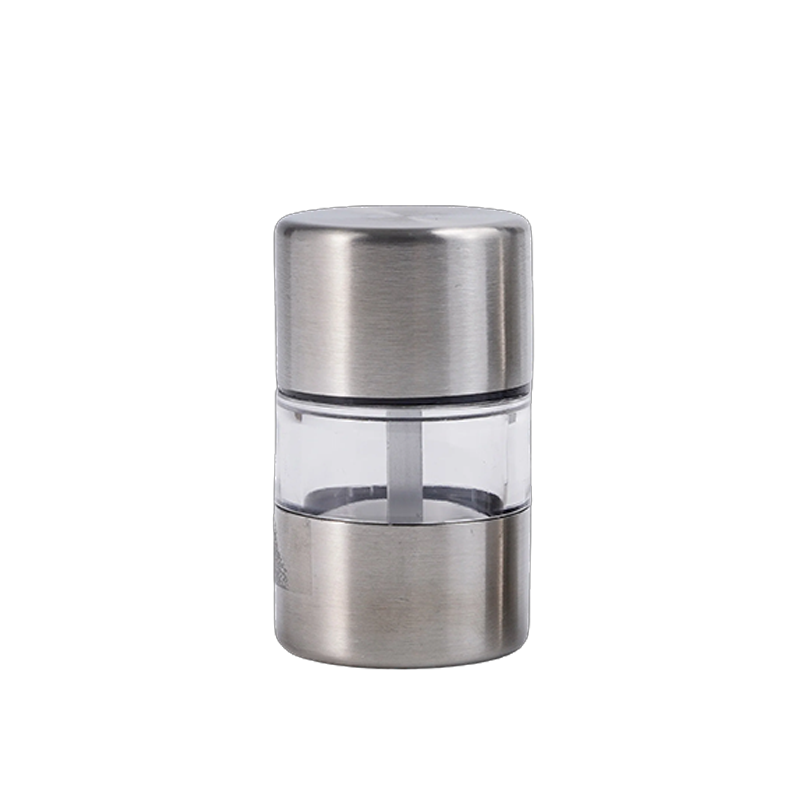
A clear or semi-transparent spice chamber lets you see fill level at a glance, eliminating the surprise of an empty mill mid-cooking. Many premium mills use borosilicate glass or clear acrylic bodies for this purpose. Fully opaque mills — however stylish — require you to unscrew the top to check the fill level.
Built-In LED Light
A feature that initially sounds like a gimmick turns out to be genuinely useful in daily cooking. Most quality electric mills now include a small LED that activates automatically when grinding.
The practical benefit: the light illuminates the food below the mill, allowing you to see exactly how much seasoning you are applying — particularly valuable when cooking over a dark-colored surface, in low kitchen lighting, or when adding finishing salt to a dark plate. In blind taste tests conducted by kitchen product reviewers, meals seasoned with LED-equipped mills showed more consistent seasoning distribution compared to mills without lights.
What to verify: the LED should activate automatically during grinding and shut off immediately after — not stay on continuously, which drains batteries faster. Warm white LEDs (2700–3000K) are preferable to cool white, as they give a more accurate representation of food color while seasoning.
Materials, Build Quality, and Durability
The outer shell materials of an electric mill affect durability, maintenance, and kitchen aesthetics — but they also have functional implications that are often overlooked.
Stainless Steel Body
304-grade stainless steel (also labeled 18/8) is the standard for premium mills. It is corrosion-resistant, easy to wipe clean, does not absorb odors, and maintains its appearance over years of kitchen use. Avoid mills that describe the material as simply "metal" or "chrome-plated" without specifying the steel grade — chrome plating over lower-grade steel will show rust within 1–2 years in humid kitchen environments.
Glass Body
Borosilicate glass chambers are food-safe, non-reactive, and visually appealing. They withstand temperature changes without cracking and do not impart any flavor to stored spices. The trade-off is fragility — a drop onto tile flooring will break most glass-bodied mills. If your kitchen has tile floors or you frequently cook in a chaotic environment, consider acrylic as an alternative.
Acrylic (Clear Plastic) Body
High-quality acrylic offers similar visibility to glass with greater drop resistance. Food-grade acrylic is BPA-free and safe for direct food contact. The main drawback: acrylic scratches more easily than glass over time, which can make the chamber appear cloudy after 2–3 years of daily handling.
IP Rating for Moisture Resistance
Kitchens are humid, and splashes happen. An electric mill with an IPX4 or higher moisture resistance rating can withstand water splashes without damaging the motor or battery compartment. Most budget mills carry no IP rating at all — meaning any significant moisture exposure risks internal damage. This is a particularly important specification if the mill will be placed near a sink or stovetop.
Key Features Comparison at a Glance
The table below summarizes what to expect at each price tier so you can match your budget to the features that matter most for your kitchen.
| Feature |
Budget ($10–$25) |
Mid-Range ($25–$60) |
Premium ($60–$120+) |
| Burr Material |
Plastic or low-grade ceramic |
Ceramic or stainless steel |
High-grade ceramic or hardened steel |
| Grind Settings |
1–3 settings |
5–6 settings |
6–8 or continuously variable |
| Motor Power |
Below 3W |
3–5W |
5–8W |
| Power Source |
AA/AAA batteries |
AA batteries or USB-C |
USB-C rechargeable |
| LED Light |
Rarely included |
Often included |
Standard |
| Body Material |
Plastic |
Acrylic + stainless accents |
304 stainless steel + borosilicate glass |
| Moisture Resistance |
None rated |
None to IPX2 |
IPX4 or higher |
| Expected Lifespan |
1–2 years |
3–5 years |
5–10 years |
Table 2: Electric salt and pepper mill features by price tier — budget, mid-range, and premium
What to Ignore When Shopping
Not every marketed feature of an electric salt and pepper mill adds real value. Knowing what to deprioritize saves money and prevents being swayed by superficial claims.
- Color options and decorative finishes: Matte black, rose gold, and brushed copper are aesthetically appealing but have no bearing on grinding performance or durability. Prioritize the mechanism and motor first, then color.
- "Lifetime warranty" claims on budget mills: A lifetime warranty on a $12 mill often means the manufacturer will offer a replacement — once — and then the brand may be discontinued. Focus on manufacturer reputation and parts availability instead.
- Extremely high RPM claims: Some product listings advertise very high motor RPM as a selling point. In practice, grinding speed is more determined by burr size and gear ratio than RPM alone. A slower-turning large burr often outperforms a fast-spinning small one.
- Gift set packaging: Mills sold in elaborate gift sets often allocate cost to packaging rather than mechanism quality. The same budget spent on a single well-engineered mill typically delivers better grinding performance.
The Bottom Line: Prioritize in This Order
When evaluating any electric salt and pepper mill, work through these features in priority order:
- First: Grinding mechanism — ceramic burr for salt, ceramic or stainless steel for pepper, burr diameter 28mm or larger
- Second: Grind size adjustability — minimum 5 settings, top-mounted adjuster preferred
- Third: Motor power — 3W minimum for everyday use, 5W+ for coarse salt or specialty spices
- Fourth: Power source — USB-C rechargeable for daily home use, AA batteries for flexibility or outdoor use
- Fifth: Ergonomics — weight under 350g when full, grip diameter 45–60mm, button accessible in natural grip
- Then: LED light, transparent body, moisture resistance rating, and material finish
A mill that scores well on the first three criteria will outperform a visually impressive competitor on every practical measure that matters in daily cooking.


 English
 русский
 Español
 Deutsch
 عربى
عربى 中文简体
中文简体



 Custom Automatic Electric Milk Frother Manufacturers